Skip to content
Our Work

Enterprise Software Case Studies

Nine engagements written up in full: the problem, the constraints we designed within, and what changed. Client names are withheld under NDA and described by category.

How to read these case studies

Each write-up follows the same shape, because it is the shape that answers a technical buyer's questions in the order they occur to them: the problem as the client stated it, the constraints that were fixed before we arrived, the architecture we chose and what we rejected, the parts that turned out harder than scoped, and what the system does now. The architecture section is the one worth reading. It is where a supplier either demonstrates that it understood the domain or reveals that it built whatever was asked for.

They are deliberately not written as success stories. Several describe a decision that was reversed, a scope that was cut, or a recommendation that reduced the size of the engagement. Those are the useful parts, and a portfolio without any of them is a marketing document rather than an engineering record.

What the nine engagements have in common

They span banking and payments, healthcare, government and enterprise manufacturing, which look like unrelated sectors and are not. In every one, the software is inspected by somebody other than its users: a regulator, an external auditor, a payment scheme, or a procurement office. That single property drives most of the engineering. It is why the transaction stores are append-only, why the audit logs are queryable by subject and by time instead of only chronologically, and why the decisions of record are produced by deterministic rules with a model kept off the critical path.

The second commonality is that integration, not feature development, consumed most of the effort. Connecting to a core banking system, a national identity service, a hospital information system or a tax authority means accepting an interface you do not control and cannot change. We write about that pattern in more depth across the industries we serve, and the engineering practices behind it on the compliance, fintech and healthcare service pages.

What we can evidence, and what we cannot

Every engagement below is covered by a non-disclosure agreement, so clients are described by category and sector rather than named. We are not able to publish logos, contract values or named references, and a supplier in this sector who does publish them for regulated clients is worth a question about how that was permitted.

Where a case study states an outcome, that figure is reported by the client and has not been independently audited, and it is marked as such rather than presented as a verified result. What we can evidence directly is the engineering: the standards each system was built to, the architecture decisions and their rejected alternatives, and the integration surfaces involved. Those are described precisely because they are the parts we are accountable for.

If you want to test any of it, the fastest route is a technical call. Bring an architecture you are considering and ask an engineer to pick holes in it. You will learn more about whether we know this domain in forty-five minutes than from any number of case studies, including these.

Nine engagements, by sector

Banking & Fintech · CoreBanking AML Suite

Screening, monitoring and goAML reporting rebuilt around an immutable transaction event stream, so any alert can be reconstructed exactly as the system saw it.

PythonReactPostgreSQLKafka
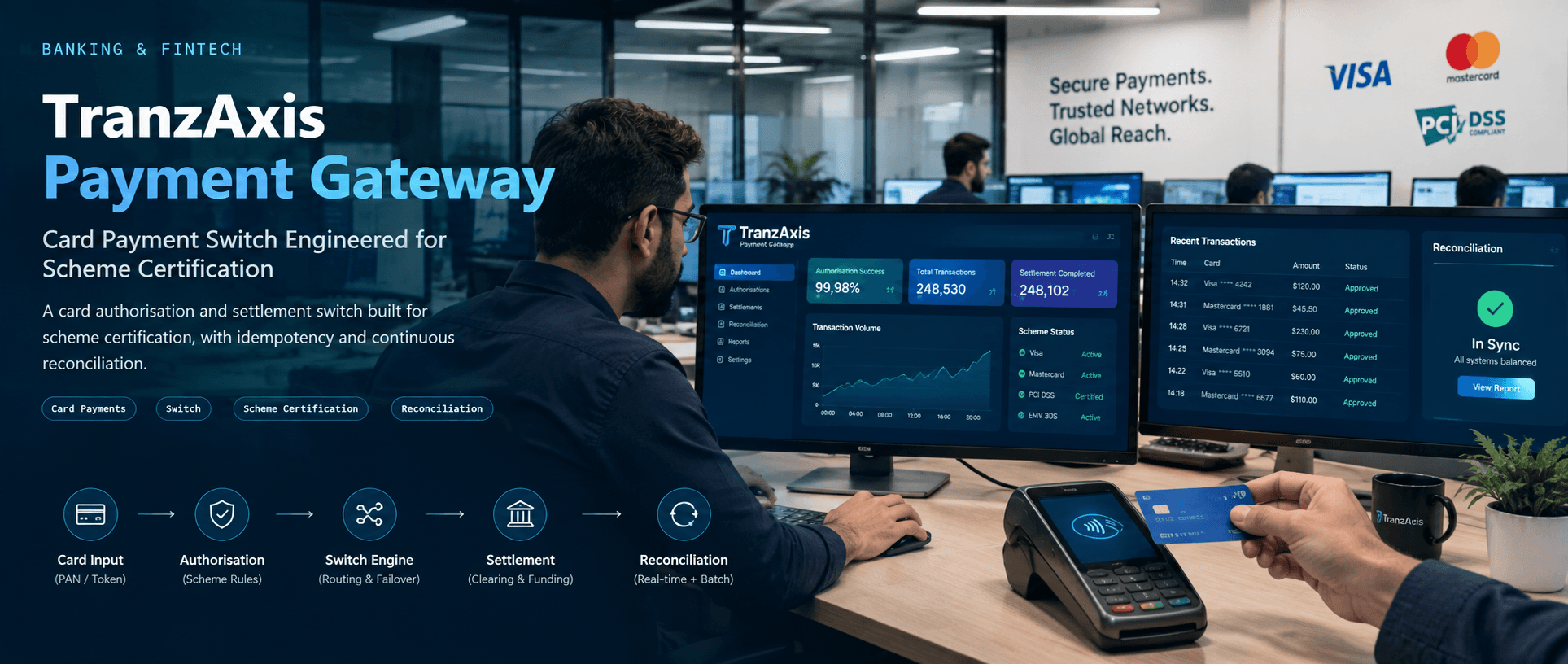
Banking & Fintech · TranzAxis Payment Gateway

A card authorisation and settlement switch built for scheme certification, with idempotency and continuous reconciliation designed in rather than added.

Node.jsGoPostgreSQLKafka
Banking & Fintech · FinSync Digital Wallet

A consumer wallet with RAAST instant payments, where settlement finality and offline conflict resolution were design decisions rather than late discoveries.

FlutterNode.jsPostgreSQL
Healthcare · MediCore EHR Platform

An EHR platform where the PHI access log was built in the first sprint and FHIR interoperability was designed as a translation layer over a clinical model.

.NET CoreAngularPostgreSQL
Healthcare · CarePulse Telemedicine App

Telemedicine where the video stack was designed for the network the patients actually have, not the one in the specification.

SwiftKotlinWebRTCNode.js
Government & Public Sector · NatID Verification Portal

Citizen identity verification against NADRA APIs with biometric authentication and PKI signing, built server-rendered and to accessibility requirements.

JavaReactPostgreSQL
Government & Public Sector · TaxLink Revenue Portal

A filing portal designed around the only traffic pattern that matters in tax: everyone arriving in the final forty-eight hours.

Java EEOracleReact
Manufacturing & Enterprise · OmniERP Manufacturing Suite

Packaged software for the commodity back office, custom engineering for the scheduling logic that differentiated the business, connected by a deliberate API layer.

.NETSQL ServerAzure
Enterprise · NovuCRM Intelligence Suite

Machine learning applied where being right most of the time is valuable and being wrong is recoverable: prioritisation, not adjudication.

ReactPythonAWSPostgreSQL
Working on Something Similar?

Every project in this portfolio
started with one conversation.

Tell us what you're working on. We'll share what we've learned from projects like it: what worked, what didn't, and what we'd do differently now. That context alone is worth the call.

Real technical discussion based on your actual requirements
Your project details are fully confidential under NDA
Written proposal with honest timelines and investment estimates
Start a conversation
Book a Free CallSend Your Project Brief

We respond within 4 business hours. If you share a detailed brief, we'll come to the call already thinking about your problem.

FAQ

Frequently asked questions

Why are your clients not named?
Every engagement shown is covered by an NDA, and we do not publish client names or logos without written permission. Clients are described by verifiable category instead: "a Tier-1 commercial bank in Pakistan", for example. This costs us credibility with some buyers and we accept that, because the alternative is disclosing a relationship somebody asked us to keep confidential.
Are the product names in these case studies real products?
No. Names like "CoreBanking AML Suite" are internal delivery codenames, labelled as such on each page. They are not commercial products you can buy, and they are not the client’s name for the system.
Are the metrics in these case studies verified?
Not yet, and each page says so. Every figure is drawn from delivery records held under NDA and is pending independent confirmation; each case study renders a provenance note stating this. Where a figure cannot be evidenced it will be removed rather than qualified; an unverifiable quantified claim is worse than no claim.
Can you provide references?
References are arranged case by case with the client’s consent, at the stage where a conversation is serious enough to justify asking them. We do not list referenceable clients publicly for the same reason we do not publish names.
What does a case study on this site actually tell me?
The problem, the constraints we had to design within, the approach, and the engineering trade-offs behind it, including what each decision cost. The engineering notes section on each page is written for a technical evaluator deciding whether we reason about their class of problem the way they would want a supplier to.

Question not answered here? Book a technical consultation; it is taken by an architect, not a salesperson.